
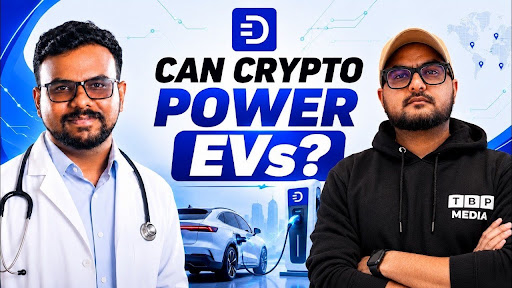
In this episode of The Blockopedia podcast, DCharge Network’s Co-founder Dr. Prakash sat down with The Blockopedia’s C0-founder Mohammad Ahmad Khan to talk about building decentralized EV charging infrastructure on Solana, why chains matter less than products these days and how community ownership became the core of DCharge’s growth model.
Dr. Prakash‘s path to crypto did not start with a whitepaper obsession, though that came soon enough. A trained medical doctor until 2013, he pivoted into engineering, earned a master’s at IIT Kharagpur, and spent years as a passive crypto investor before the pandemic era DeFi summer pulled him toward actually building. He traced that shift back to reading Mastering Bitcoin and Mastering Ethereum, the open source books that gave him, in his words, a nuanced understanding of concepts like nonces and transaction hashes that no amount of passive investing ever could.
That hands-on instinct eventually led him to DCharge Network, the decentralized EV charging project he co-founded around early 2024 alongside serial entrepreneur Mohan, whose background spans hardware and EV fleets.
Spotting the Gap Nobody Else Was Solving
The idea came from a simple observation. Food delivery fleets across metro cities were rapidly electrifying, but riders had no brand loyalty to any single charging network. They just needed reliable charging wherever they happened to be, without diverting capital away from their core delivery operations. Dr. Prakash and his co-founder built their own hardware, wrote custom firmware, and constructed the protocol from scratch, scaling to 50 paying customers within three months, deliberately before approaching any investors.
That distribution first mindset, he explained, is what separated DCharge from companies that raise money on a pitch deck alone. The team looked to Helium’s US growth model as inspiration and pitched a fractionalized, community owned charging network instead of trying to own the full stack themselves. Today, more than half of DCharge’s roughly 2,000 charging nodes, most concentrated across Asia, are owned by community members rather than the company itself.
What Colosseum Actually Taught Him
Ahmad asked about Dr. Prakash’s hackathon experience, noting how many developers now hop between ecosystems chasing grants without much strategy. Dr. Prakash pushed back gently on that framing. In his view, chains no longer matter as much as they used to; products need chains, not the other way around. His advice to builders was blunt: stop planning and start hacking, aim for five or six hackathon experiences before expecting to win anything, and prioritize meeting people in person over building alone in a room.
DCharge became the first Asian team to win Colosseum’s startup competition, and Dr. Prakash credited the program’s six to eight week in person component, along with direct mentorship from Solana figures like Raj Gopal and Anatoly Yakovenko, as more valuable than the funding itself. The team went on to raise a venture round led by Lemniscap shortly after.
Explaining DCharge in Plain Terms
Asked to break the project down for someone completely outside crypto, Dr. Prakash described DCharge simply as an aggregator of charging point operators. Anyone with a good location and real EV traffic nearby can get a charging station installed through DCharge’s own capital, community capital, or partner operators, without needing to front the tens of thousands typically required to install charging infrastructure themselves. Roughly 40 percent of current devices are already sponsored by backers in the US who understand the underlying incentive model even before any token has launched.
Ahmad offered his own read on the appeal, framing it as something apartment residents or building owners could realistically host in a parking lot to generate steady income while serving their own community, a framing Dr. Prakash confirmed matches exactly how the two sided marketplace is designed to work.
Why Real World Utility Matters Now
Dr. Prakash was pointed about how differently this generation of DePIN projects needs to operate compared to earlier crypto cycles. Device holders on DCharge have already received network rewards without a token even existing yet, which he contrasted with the NFT era’s habit of expecting value to appear without any underlying business generating it. With EV adoption still climbing and charging infrastructure chronically short of demand, he sees the next few months bringing expanded geographic campaigns and deeper partnerships across the Solana ecosystem.
Watch the full conversation: https://www.youtube.com/watch?v=XJEYPfiICQ0

